- AI Paradox
- Posts
- Hollywood x AI: The Next Big Crossover
Hollywood x AI: The Next Big Crossover
U.S. AI revenue doubles China and more...

Raj C
October 26, 2025
Hey folks, Stay ahead with the latest in AI—let’s dive in!
WHAT YOU’LL READ TODAY
Google Earth AI gets Gemini-powered geospatial reasoning
AI boom drives 3.6% jump in utility bills
Palantir secures $200M+ AI partnership
Wonder Studios Secures $12M to Redefine AI’s Role in Hollywood
And more…
QUICK NEWS
Google Earth AI gets Gemini-powered geospatial reasoning – Google unveiled Geospatial Reasoning, a Gemini-powered framework that integrates multiple Earth AI models—such as weather forecasts, population density data, and satellite imagery—to enable more advanced analysis. Instead of simply mapping where a storm might strike, analysts can now identify which communities are most vulnerable and which infrastructure assets are at greatest risk in a single view.
AI boom drives 3.6% jump in utility bills, Bank of America says – U.S. consumer utility payments rose 3.6% year-over-year in Q3 2025, according to Bank of America. Economist David Tinsley attributed the increase to soaring electricity demand from AI data centers, noting that the rapid expansion of infrastructure to power AI workloads is straining the grid and raising costs for all ratepayers.
Palantir secures $200M+ AI partnership with Lumen – Lumen Technologies will invest more than $200 million over several years in Palantir’s Foundry and AI Platform, integrating them with its edge computing and broadband infrastructure. The partnership builds on Palantir’s role in helping Lumen cut $350 million in costs in 2025, with the company now targeting $1 billion in savings by 2027.
LATEST UPDATE
Wonder Studios Secures $12M to Redefine AI’s Role in Hollywood

Source: TechCrunch
London-based AI creative studio Wonder Studios has secured $12 million in seed funding led by Atomico, with participation from executives at OpenAI, Google DeepMind, and ElevenLabs. The company gained attention for producing Lewis Capaldi’s “Something in the Heavens” AI-generated music video in collaboration with DeepMind, YouTube, and Universal Music Group, and for launching its original anthology series “Beyond the Loop,” which hit 1.5 million views and earned a renewal for a second season. With the new capital, Wonder plans to double its 15-person engineering team and expand into IP ownership and original content production. The startup frames its mission as creating a “Hollywood without borders,” focused on democratizing AI storytelling tools for creators around the world.
AI remains a flashpoint in entertainment, with artists warning that LLM-based tools could erode creative jobs or replicate performances without consent—a controversy amplified by OpenAI’s Sora 2. Wonder’s approach differs: it’s betting on collaboration instead of automation, building a platform that helps filmmakers access resources and monetization rather than replacing them. This positions the company as a bridge between technology and creators, not a disruptor tearing down the old system. Yet the core tension persists—AI will either empower artists or render many redundant. Wonder’s community-first strategy is both a savvy narrative and a high-stakes gamble. Its $12M raise shows investors see potential in coexistence, but history suggests creative industries rarely adapt without casualties.
US AI Revenue to Nearly Double China’s in 2025
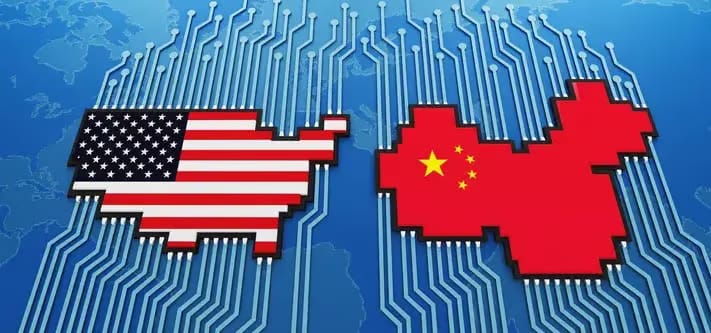
Source: Forbes
The US AI market is projected to generate $41 billion in revenue in 2025, nearly double China’s $24 billion, according to GlobalData’s AI Global Market Opportunity Forecasts to 2029. Within that, the US generative AI market alone has reached $2.4 billion, with nearly 70% of US enterprises now using AI in some form. America’s lead stems from its early adoption culture, a mature innovation ecosystem of chipmakers, cloud providers, and software developers, and government support through policies like the CHIPS Act. Meanwhile, the Asia-Pacific region has recorded the fastest growth rate (2020–2025), fueled by state-backed AI initiatives in India and South Korea that are rapidly expanding regional capabilities.
The growing US-China AI revenue gap highlights an infrastructure imbalance, not just a difference in innovation. The US excels at commercializing AI quickly across high-value sectors like banking and IT, where compliance and data security are critical. China, however, is catching up fast—projects like DeepSeek have shown it’s possible to build competitive AI models on restricted hardware. Yet the focus on revenue misses a deeper shift: China is outpacing the US in physical AI integration, deploying 6–7 times more industrial robots and embedding intelligence directly into manufacturing.
The US is winning commercially, but China is winning strategically. The $41B vs. $24B gap looks impressive until you account for China’s faster GDP growth, massive industrial base, and tight integration of AI with physical infrastructure. The CHIPS Act is a defensive measure—propping up a lead that’s already under pressure. Meanwhile, China’s AI strategy is coordinated across industry, robotics, and research, forming a unified national push. The DeepSeek R1 model, built for just $6 million using restricted chips and then open-sourced, demonstrated how China is leveraging soft power to win developer loyalty globally. The US may dominate near-term revenue, but by 2030, the real question isn’t who sold more AI software—it’s who owns the infrastructure where AI lives.
POPULAR TOOLS
Chaindesk – A no-code platform for building custom AI chatbots powered by your own data.
Iconik AI – Instantly generate professional-quality app icons for Android, iOS, and web—no design experience required.
Fill3D – Transform empty rooms into realistic, furnished spaces with AI-powered virtual staging.
Jason AI – Automate B2B outreach, conversations, and meeting scheduling with intelligent chat automation.
That’s all for now — thanks for spending a few minutes with us today. We hope you found something valuable to carry into your week. Got thoughts, feedback, or just want to say hi? We’d love to hear from you. Until next time, stay curious and keep moving forward.
-Team AI Paradox